Last updated October 15, 2026
How to Hire an ADU Contractor in San Jose: A Step-by-Step Guide
The most common complaint filed with the California Contractors State License Board isn’t shoddy workmanship. It’s scope creep on a verbal agreement. ADU projects get hit harder than most because the scope is genuinely complex: foundation work, plumbing, electrical, zoning setbacks, fire ratings, and finish carpentry all have to come together on a tight urban lot in San Jose. Most homeowners don’t know which questions to ask before signing, so they end up with a contract that reads more like a wish list than a legal document. This guide walks through a specific vetting sequence that catches the three contract gaps that let a bad project spiral before anyone breaks ground, and points to more guides & resources once you’re ready to dig deeper. By the end, you’ll know exactly what to verify, what to put in writing, and which red flags walk away from.
Quick Answer
To hire an ADU contractor in San Jose, verify the contractor’s CSLB license, bond, and insurance before anything else, then require a written price lock, a defined change-order trigger, a lien waiver schedule, and a written punch-list process in the contract. Compare bids line by line, not by bottom-line price. If a contractor won’t put the scope in writing before work begins, don’t sign.
Table of Contents
- The Ten-Minute License Check Every San Jose Homeowner Should Run
- The Four Contract Clauses That Prevent 80% of ADU Disputes
- How to Compare ADU Bids That Look Equal on Price
- Red-Flag Interview Answers That Signal Future Problems
- What a Written Guarantee Covers vs. What California Law Already Requires
- San Jose-Specific ADU Considerations
- The Selection Sequence: From First Call to Signed Contract
- Common Mistakes to Avoid
- When to Call a Professional
- Frequently Asked Questions
- The Bottom Line
The Ten-Minute License Check Every San Jose Homeowner Should Run
Before you discuss floor plans, finishes, or timelines, run the license. It takes less than ten minutes and eliminates the riskiest tier of contractors. Here’s the exact sequence we recommend to anyone in San Jose.
First, go to the Contractors State License Board website at cslb.ca.gov and click “Check a License.” Enter the contractor’s name or license number. What you’re looking for is a license status of “Active” – not “Expired,” not “Suspended,” not “Inactive.” Any other status means the contractor cannot legally work in California. That’s the first filter.
Second, verify the license classification. For a full ADU build, you want a Class B General Building contractor or a Class C specialty contractor for the specific scope (C-5 for framing, C-36 for plumbing, C-10 for electrical, and so on). A Class B can manage the entire project and pull the building permit. If the contractor only holds a specialty class, they legally can’t run the whole ADU job. They’d need to work under a general contractor. Knowing the difference changes who you sign with.
Third, check the bond. California requires a $25,000 contractor’s license bond. The CSLB listing will show whether it’s active. The bond protects you if the contractor violates the law, but it’s not a warranty on the work. Think of it as a minimum threshold, not a safety net.
Fourth, request a certificate of insurance directly from the contractor’s insurance agent. Verify general liability coverage of at least $1 million and workers’ compensation coverage for any employee who steps onto your property. If a worker gets injured on your ADU site and the contractor doesn’t have workers’ comp, the claim can fall back on your homeowner’s insurance. In San Jose, where garage conversions and backyard ADUs are dense urban infill projects, the risk is real: crews work in tight quarters near property lines, overhead lines, and existing structures.
We’ve seen homeowners skip this step because “the contractor seemed honest.” That’s not a verification. The entire check can be done on your phone during a lunch break. Run it before the first interview, and you’ll eliminate the bottom tier of the market without a single conversation.
The Four Contract Clauses That Prevent 80% of ADU Disputes
Most ADU disputes we hear about in San Jose trace back to one of four contract gaps. Close these gaps before signing and you’ve removed the most common sources of scope creep, surprise invoices, and stalled projects. Here they are, in the order they matter.
1. Written price lock with a defined trigger for any change. The contract should state the exact dollar amount you’ll pay for the defined scope. Not an estimate. Not a range. A number. And it should specify that any change to that number requires a written change order signed by both parties before the additional work begins. “We’ll figure it out as we go” is how a $180,000 ADU becomes a $240,000 ADU. In California, the Home Improvement Contract law actually requires a written contract with a price for work over $500. If a contractor won’t put the price in writing, they’re already out of compliance.
2. Change-order trigger definitions. A change order is the formal process for altering the scope. But most contracts never define when one is required. Good contracts say something like: “Any change to materials, fixtures, square footage, or concealed conditions discovered during demolition shall trigger a written change order. No work beyond the original scope begins without a signed change order.” This single clause prevents the classic mid-project surprise: “We opened the wall and found old wiring. That’ll be another $8,000.” If old wiring is likely in a San Jose home built before 1980, the contract should address how concealed conditions get priced.
3. Lien waiver schedule. When you pay a general contractor, they pay their subcontractors. But if the general contractor fails to pay a subcontractor, that subcontractor can file a mechanic’s lien against your property – even if you already paid the general contractor. A lien waiver schedule ties every progress payment to signed waivers from all subcontractors and suppliers who have worked on the project up to that point. You release payment only after you receive the waivers. This isn’t optional. In San Jose’s competitive ADU market, where subcontractor capacity is tight, lien disputes are a recurring issue. The waiver schedule is your line of defense.
4. Defined punch-list process. A punch list is the final walkthrough list of small, incomplete, or defective items: a cabinet door that doesn’t close flush, a scuff on a wall, a light switch in the wrong spot. Most contracts mention a punch list but don’t define the timeline. Good contracts specify that the contractor and homeowner walk through together at substantial completion, create a written punch list, and complete all items within a defined period – 14 days, 21 days, whatever you agree on – before final payment is released. Without this, a “finished” ADU can sit with a half-dozen small defects for months while the contractor has moved on to the next job.
We’ve walked through dozens of contracts with San Jose homeowners. These four clauses resolve the majority of disputes that reach the CSLB. They cost nothing to include. They take one conversation to negotiate. They’re worth more than any discount.
How to Compare ADU Bids That Look Equal on Price
Two contractors quote you $220,000 for a 749-square-foot detached ADU with a one-bedroom layout. Two identical numbers. But the bids are not equal, and the difference shows up in the line items. Here’s what low bidders routinely omit, and how to catch it before signing.
The missing line items checklist:
- Permit fees and plan check costs. San Jose’s ADU permit fees, school impact fees (currently waived or reduced under state ADU law for units under 750 square feet, but verify current status with the City of San Jose Building Division), and utility connection fees can run $15,000 to $35,000 depending on scope and existing infrastructure. If a bid doesn’t include a permit line item, ask whether it’s included or excluded. Excluded is fine if you know about it. “Oh, that’s extra” when the permit is ready to pull is not.
- Utility trenching and connections. A detached ADU needs water, sewer, and electrical service. If the ADU site is 60 feet from the main panel and the sewer cleanout, trenching costs money. Some bids assume “standard” connection distances. Ask whether the bid includes the actual trench length for your lot. In San Jose’s older neighborhoods like Rose Garden or Willow Glen, existing sewer laterals may need repair or replacement, which adds cost.
- Site preparation and foundation work. Flat concrete work is one price. Sloped lots, expansive soil, or tree root removal changes the foundation cost. San Jose lots vary widely. If your yard slopes toward the back fence, the foundation bid needs to include more than a slab.
- Finish level definitions. “One bath” is not a spec. Does the bid include the specific vanity, tile, fixtures, and shower glass at the allowance levels you discussed? Low bids often assume builder-grade everything. If you want mid-grade fixtures, that’s thousands more – but it should be in the bid, not a change order later.
- Demolition and disposal. A garage conversion includes demo: removing the garage door, maybe cutting concrete, hauling debris. Some bids skip disposal fees or undercount dump runs. Each dump run in the Bay Area can cost $600 to $900.
The right way to compare bids is to lay them side by side and highlight every line item. If one bid is 15 percent lower with the same quoted scope, the money is coming from somewhere – usually an omitted line item that becomes a change order later. In our experience in San Jose, the low bidder doesn’t end up cheaper. They end up cheaper on paper and more expensive by final payment.
Red-Flag Interview Answers That Signal Future Problems
Interviews reveal more than bids. The way a contractor answers questions tells you how they’ll behave when problems come up – and problems always come up on an ADU. Here are answers we’ve heard in San Jose living rooms that should end the conversation.
“We’ll figure out permits as we go.” This is the single biggest red flag in ADU contracting. Permits are not a detail to handle mid-project. In San Jose, a detached ADU requires a building permit, a plot plan, structural calculations, Title 24 energy compliance, and often a fire sprinkler requirement for units over a certain size or distance from the main house. For a full walkthrough of the process, see ADU Permits, Codes & Inspections in CA: What You Need to Know. A garage conversion requires a change of use. The permit path is part of the upfront scope. “We’ll figure it out” means you’ll be the one holding an unpermitted ADU that can’t be rented, can’t be included in a sale, and may need to be torn down if the city catches it. Walk away.
“I don’t need a written change order with you – I trust you.” Trust has nothing to do with it. A written change order protects both parties. This answer means the contractor either doesn’t understand contract law or wants to keep the door open for verbal changes that inflate the price. Either way, the project is at risk.
“My subs will be on site when they can get here.” Subcontractor scheduling determines whether your ADU takes 5 months or 14 months. A contractor who can’t commit to a construction schedule with defined milestones either doesn’t have established subcontractor relationships or doesn’t control their job sites. Ask for the schedule in writing: when demolition starts, when foundation pours, when framing inspections happen, when drywall goes in, when the final inspection is scheduled. If the contractor won’t put dates next to phases, expect a project that stretches long past your timeline.
“That price is just a starting point.” In California, a home improvement contract over $500 requires a written price. “Starting point” isn’t a price. It’s an invitation to scope creep. If the contractor can’t commit to a number for a defined scope, you don’t have a bid – you have a conversation.
“You don’t need to see my insurance – I’ve never had a claim.” Every legitimate contractor carries general liability and workers’ compensation insurance and can produce the certificate in one email. If they can’t or won’t, they’re either uninsured or their coverage lapsed. In San Jose, where tight ADU sites mean crews work close to your home and your neighbor’s property, the stakes are too high to take someone’s word for it.
What a Written Guarantee Covers vs. What California Law Already Requires
There’s a difference between what the law gives you and what a contractor voluntarily promises. Understanding the gap helps you evaluate which contractors are actually standing behind their work.
California law already requires a few things. Contractors must be licensed and bonded with the CSLB. They must provide a written contract for home improvement work over $500. They must follow the state’s lien law, which gives subcontractors the right to file a mechanic’s lien if they’re not paid. And California has a one-year warranty on workmanship implied in most home improvement contracts: if the work fails due to poor installation or materials within one year, the contractor is generally responsible for correcting it. But “generally responsible” and “will actually come back” are different things in practice.
A written guarantee goes further. It names what’s covered, for how long, and what happens if it fails. Here’s what a legitimate written guarantee on an ADU should include:
- Workmanship warranty period. One year is the legal floor. A contractor confident in their work may offer longer. At Lodgewick ADU San Jose, we provide the 365-Day Done Right Promise: if the work isn’t right, we come back and make it right – and that commitment is in writing on every project.
- Scope of the guarantee. Is it just workmanship, or does it extend to materials and systems? A written guarantee should name what’s covered: structural integrity, waterproofing, electrical systems, plumbing, finish work. The more specific, the better.
- Response commitment. If something fails inside the guarantee period, what happens? At Lodgewick, the guarantee includes a free return visit if the work fails within the 365-day period. That’s the difference between a promise and a mechanism: the homeowner knows exactly what to do and who to call.
There’s also the prefab angle. If you’re building with a prefab ADU from a manufacturer like Boxabl or Plant Prefab, the manufacturer’s warranty on the structure is separate from the contractor’s warranty on the site work, foundation, and connections. A good ADU contractor will explain who covers what before you sign anything. A bad one will let you discover the gap after something goes wrong. For homeowners who prefer traditional module construction, James Hardie siding carries a manufacturer warranty that’s worth understanding too. We’ve worked with all three and walk through the warranty structure with homeowners before finalizing a contract.
San Jose-Specific ADU Considerations
San Jose has a particular ADU market. It’s not like building in a sprawling exurb or a rural county. The city’s lot sizes, building codes, and market dynamics shape almost every decision. Here’s what matters for San Jose specifically.
Lot conditions vary by neighborhood. In Willow Glen and Rose Garden, you’re often working with older homes on tree-lined lots with mature root systems. Roots complicate foundation work and utility trenching. In Evergreen and Almaden Valley, many lots are larger, but grading can vary significantly. In downtown-adjacent neighborhoods like Naglee Park or Japantown, setbacks are tighter and the building envelope is more constrained. A contractor who’s built ADUs across San Jose’s different neighborhoods will have a better read on what your particular lot requires than someone who’s only built in one part of the city.
Climate shapes design choices. San Jose runs hot and dry in summer, with average highs above 80°F from June through September. ADUs without shade or air conditioning become unusable August boxes. Title 24 energy compliance in San Jose means your ADU needs proper insulation, window orientation, and cooling. A good ADU builder in San Jose designs for this climate: roof overhangs, ceiling insulation levels, window placement that catches afternoon shade. Cheap builds skip these details and the homeowner pays in utility bills.
Permit timelines are what they are. San Jose’s Building Division has worked to streamline ADU permit processing, but the process still takes time. Plan review, corrections, resubmission, and approval can run 4 to 12 weeks depending on complexity and the current queue. A contractor who’s familiar with the city’s current plan check expectations can save you weeks of back-and-forth. A contractor who doesn’t regularly pull San Jose permits will burn your timeline learning the department’s preferences.
Garage conversions are the most popular path. Many San Jose homes already have attached or detached garages that are poorly used as storage. Converting that garage into a living unit is often cheaper and faster than a ground-up build because the foundation, roof, and basic structure already exist. But garage conversions have their own code requirements: the floor height may need adjustment, the existing slab may need insulation, and the garage opening gets reframed into a wall with windows or a door. We’ve done dozens of these across San Jose. A garage conversion contractor in San Jose should be able to walk through exactly what your specific garage needs – not just quote a generic square-footage price.
Schools and rental demand shape resale value. San Jose ADUs are often built as rental units – long-term or ADU-specific uses. The rental market in San Jose varies by school district and transit access. An ADU near a good San Jose school or a light rail corridor rents faster and commands a higher rate. If you’re building to rent, consider this before choosing your project scope. It affects unit size, layout, and finish level.
The Selection Sequence: From First Call to Signed Contract
Here’s the step-by-step sequence we recommend to any San Jose homeowner starting an ADU journey. It’s designed to eliminate risk in order, from cheapest to filter to most expensive. Each step builds on the previous one.
- Run the license check first. Before the first phone call, verify the CSLB license, classification, bond, and insurance certificate. Ten minutes. No exceptions.
- Request references from the last two ADU projects. The last two, not the best two. Any contractor can hand over a happy client from three years ago. Ask for the most recent jobs and call both homeowners. Ask how the schedule held, how change orders were handled, and whether the punch list got done.
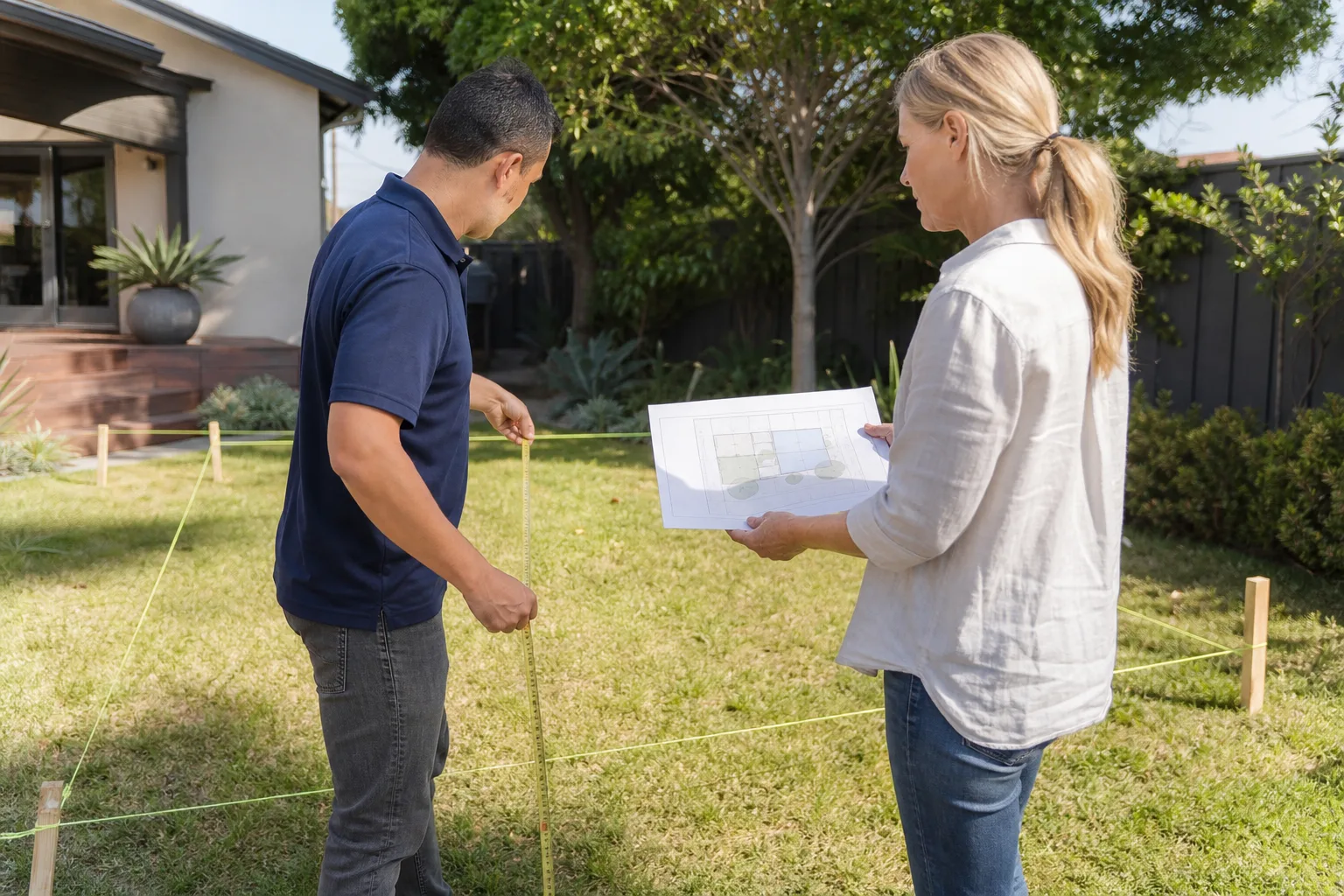
- Schedule on-site walkthroughs with two or three contractors. A serious contractor needs to see your lot before quoting. Anyone who quotes without a site visit is giving you a guess, not a bid. During the walkthrough, ask them to point out challenges they see on your specific lot – grading, access, utility locations, tree roots. The contractor who identifies real constraints is the one who’s actually thinking about your project.
- Request written bids with full line items. Permit fees, utility trenching, foundation assembly, framing, roofing, plumbing rough-in, electrical rough-in, insulation, drywall, flooring, fixtures, finishes, painting, punch list. If a line item is missing, ask whether it’s excluded intentionally. Get each bid in the same format if possible so you can compare line by line.
- Request the written contract with the four clauses. Before you sign, the contract should include the written price lock, change-order trigger definitions, lien waiver schedule, and a defined punch-list process. Sit down and read it. All of it. If it’s vague on these four points, ask for revisions.
- Confirm the guarantee in writing. The guarantee should be a document, not a handshake. It should name what’s covered, for how long, and what happens if something fails. Lodgewick ADU San Jose includes the 365-Day Done Right Promise in writing with every project. That’s the standard you want from anyone.
We’ve seen this sequence catch bad contractors at every step. A license check that failed. A reference who told the truth about six months of delays. A bid with no permit line. A contract with no change-order trigger. Each filter removes risk. By the time you sign, you’ve already tested the contractor on the things that matter.
Common Mistakes to Avoid
- Skipping the license check because a friend recommended them. Friends recommend based on personality and price, not license status and insurance coverage. The CSLB check takes ten minutes. Run it regardless.
- Signing based on the lowest bid without comparing line items. In San Jose’s ADU market, the low bid is low because something is missing. Identify what that something is before you commit.
- Accepting a verbal price without a written contract. California requires a written contract for home improvement work over $500. If a contractor won’t write the price down, they’re telling you who they are.
- Paying too much up front. The legal maximum down payment in California is 10 percent or $1,000, whichever is less. Progress payments should follow completed milestones, not arbitrary calendar dates. Structure the payment schedule around inspections passing.
- Ignoring the lien waiver schedule. You can pay the contractor in full and still face a mechanic’s lien from an unpaid sub. Written waivers on every payment close this gap.
- Building an unpermitted ADU to save money. San Jose’s enforcement on unpermitted ADUs has real teeth: fines, stop-work orders, and the requirement to legalize or remove the structure. An unpermitted ADU can’t be rented legally, can’t be included in an appraisal, and creates liability headaches for insurance. The savings never pencil out.
- Assuming a manufacturer’s warranty covers everything on a prefab ADU. A Boxabl or Plant Prefab structure warranty covers the factory-built components. The site work, foundation, utilities, and connections are covered by the contractor – or not covered at all if the contractor didn’t provide a written guarantee. Know who covers what.
When to Call a Professional
Some homeowners wonder if they can manage an ADU project themselves as an owner-builder, managing subs and pulling permits. It’s legally possible in California, but it’s rarely the right choice for a project this complex. If your project involves utility trenching, foundation work, structural modifications to an existing garage, new electrical service, or any work that requires engineered plans, call a professional. If you want the work covered by a written guarantee that someone will actually honor, that’s a professional commitment, not a DIY one. If you’ve been through a bad contractor experience before and aren’t sure how to spot the next one, call someone who can walk you through the sequence above. Lodgewick ADU San Jose offers free estimates in San Jose – call (669) 266-4319.
Frequently Asked Questions
A detached ADU in San Jose typically runs $200,000 to $350,000 for a 500 to 1,000 square foot unit, depending on site work, finishes, and whether prefab is used. Garage conversions run $120,000 to $220,000 because the existing structure reduces foundation and framing costs. Call (669) 266-4319 for an exact quote based on your lot and scope – estimates are free.
Plan on 8 to 14 months from contract signing to final inspection: 1 to 3 months for design and permits, then 5 to 9 months of construction depending on scope, site conditions, and inspection scheduling. A garage conversion can complete faster than a ground-up detached build. The schedule should be in writing before you sign.
Yes. Every ADU in San Jose requires a building permit from the City of San Jose Building Division. A detached new build also needs a plot plan, structural calculations, and Title 24 energy compliance. A garage conversion requires a change of use. No permit means no legal rental, no resale value, and liability if something goes wrong.
A JADU (junior accessory dwelling unit) is created by converting a portion of the existing home – often a bedroom or attached garage – into a separate unit up to 500 square feet. A detached ADU is a standalone structure on the same lot, up to 1,000 square feet in most San Jose zones under current state ADU law. JADUs cost less but give less privacy and rental independence.
Prefab ADUs from manufacturers like Boxabl and Plant Prefab can cut build time significantly because the structure is factory-built while site work happens in parallel. The tradeoff is less design flexibility and the need for a contractor experienced with prefab site connections. Our team has worked with both and can help you compare the total installed cost against traditional construction for your specific lot.
Yes, but less than you might expect. The new ADU construction triggers a reassessment on the added value, not the entire property. The added value is typically far less than the project cost – often 40 to 60 percent. A $250,000 ADU might increase annual property taxes by $1,100 to $1,700 in Santa Clara County. It’s worth confirming the specifics with the County Assessor’s office for your exact scenario.
A guarantee is only worth the mechanism behind it. Look for three things: the guarantee is in writing with named coverage, the response commitment is specific (who you call, what happens, how fast), and the contractor has a track record of honoring it. The Kingswell Guarantee at Lodgewick ADU San Jose includes the 365-Day Done Right Promise in writing on every project, with a free return visit if something fails inside the guarantee period. If a contractor won’t write the guarantee down, it doesn’t exist.
The Bottom Line
Hiring an ADU contractor in San Jose isn’t about finding the cheapest bid. It’s about running a verification sequence that filters out the three contract gaps that cause scope creep, surprise change orders, and stalled projects. Verify the license and insurance in ten minutes. Require a written price lock, change-order triggers, a lien waiver schedule, and a punch-list process before you sign. Compare bids line by line, not by total. Trust the interview answers that sound like a professional, not a sales pitch. And get the guarantee in writing. Do that, and you’ll build an ADU that adds space and value to your San Jose home without the nightmare stories. If you’re ready to start, call (669) 266-4319 for a free estimate – a live person answers, and the price comes in writing.
Written by Russ Delmar, Owner at Lodgewick ADU San Jose, serving San Jose since 2010.